



Prevent Garbage Cans From Blowing Over in Wind
Table of Contents
- What Wind Speed Tips a Garbage Can and Why It Matters
- How to Secure Trash Cans From Animals and Wind
- Trash Can Wind Anchor Options That Actually Hold
- DIY Trash Can Tie Downs: What Works and What Fails
- Strategic Placement to Reduce Wind Exposure
- DIY vs. Commercial Solutions: A Cost-Benefit Breakdown
- Safety and Compliance During High-Wind Events
- Frequently Asked Questions
Last Updated: September 27, 2026
What Wind Speed Tips a Garbage Can and Why It Matters
A 40 mph gust can knock over an empty garbage can. Once the lid pops open, the wind grabs it like a sail, and your trash ends up scattered down the street. Learning to prevent garbage cans from blowing over in wind starts with understanding one simple fact: the problem is not the wind itself. It is the exposed surface area of the lid and the lack of a fixed anchor point.
How to Secure Trash Cans From Animals and Wind
Securing trash cans from animals and wind uses the same basic approach: lock the lid down and stop the cart from tipping. A raccoon pushing on a lid and a gust lifting it apply force in different directions, but a strap or latch that holds under one usually holds under the other.
Why Animals and Wind Are the Same Problem
An animal stands on the rim and pulls the lid up. Wind gets under the lid edge and pushes it up. In both cases, the lid is the weak point. If the lid stays shut, the cart is far harder to tip and nothing inside becomes debris.
Choosing the Right Locking Hardware
Look for hardware that attaches to the cart itself, not just over the top. A strap bolted through the lid and body with stainless steel fasteners will not slide off the way a loose bungee cord does.
- Bungee cords: cheap, but they stretch, rust, and snap in cold weather.
- Ratchet straps: strong, but slow to undo at the curb on collection day.
- Bolted lid straps: permanent, weather-resistant, and one-hand operable.
Trash Can Wind Anchor Options That Actually Hold
A trash can wind anchor works by connecting the cart to the ground or adding enough mass that the wind cannot tip it. The right choice depends on your surface, your cart type, and how often you move the bin.
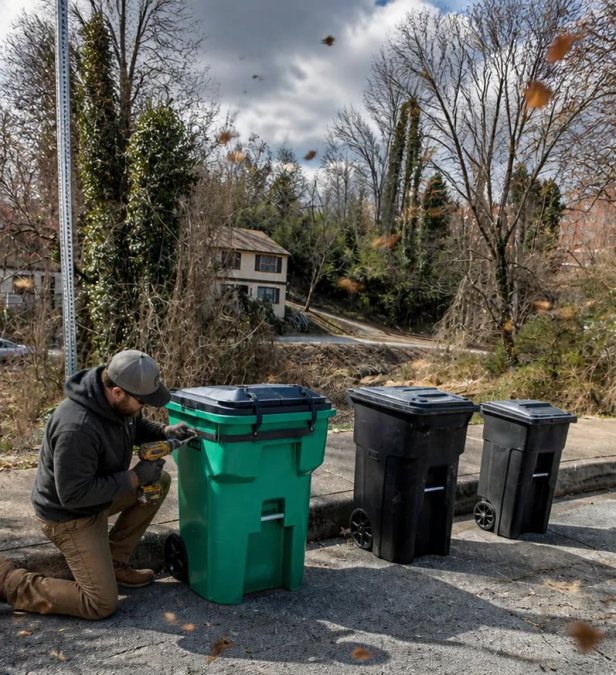
Homeowner using a drill to secure a strap and prevent garbage cans from blowing over in wind on a stormy day
Ground Anchors and Stakes
Ground stakes work on grass and dirt but fail on concrete and asphalt. A stake driven through the cart's handle or a strap loop keeps the bin from tipping and blow-over. For renters or anyone with a paved pad, a wall-mounted anchor point is a better fit.
What actually holds on each surface:
- Turf and soil: A 12-inch spiral or auger-style ground anchor (the kind sold for tying down dogs or small sheds) screwed into the lawn holds far better than a straight tent stake, which pulls out under lateral load. Run a short strap from the anchor to the cart handle.
- Concrete and asphalt: You cannot drive a stake. Use a wall anchor, a heavy-duty eye lag screwed into a garage wall stud, a fence post, or a concrete wedge anchor, and tether the cart to it with a strap short enough that the bin cannot reach a tipping angle.
- Gravel and mulch beds: These behave like loose soil. A wide-flange stake or a screw-in anchor with a plate spreads the load and resists pull-out better than a thin spike.
Matching the Anchor to the Cart
Round and square carts catch wind differently. A square cart presents a flat face to the wind and tips as a unit; a round cart sheds some flow but its curved lid edge is easier for a gust to peel up. Either way, the anchor point should be on the cart body or handle, never the lid alone, a lid-only tether transfers the whole wind load to the hinge and lid, which is the part most likely to fail first.
DIY Trash Can Tie Downs: What Works and What Fails
DIY trash can tie downs range from reliable to useless. The difference usually comes down to whether the tie-down is anchored to the cart or just draped over it.
What works:
- Bolted straps with stainless hardware
- Stakes through a handle loop on grass
- Wall hooks with a short strap on paved pads
What fails:
- Bungee cords over the lid (stretch and snap)
- Rope tied to a fence post (loosens and slips)
- Rocks on the lid (blow off and become projectiles)
Strategic Placement to Reduce Wind Exposure
Placement is the cheapest fix available, and most homeowners skip it. Where you park the cart changes how much wind it catches.
- Face the lid hinge into the wind, not the opening edge.
- Keep carts out of gaps between buildings where wind speeds up.
- Group multiple bins together to share wind resistance.
DIY vs. Commercial Solutions: A Cost-Benefit Breakdown
Commercial solutions cost more up front but last longer and hold up in real storms. DIY options are cheaper but need replacing more often. The honest comparison is not just sticker price, it is cost per season of reliable service, plus whether the fix survives a collection crew.
Option |
Upfront Cost |
Durability |
Best For |
|---|---|---|---|
Bungee cords |
Low |
Weeks to months |
Short-term fixes |
Rope and stakes |
Low |
One season |
Grass placement |
Bolted lid straps |
Moderate |
Years |
Wind and animals |
Ballast alone |
Low |
Ongoing |
Tipping only |
The Real Cost Math
A pack of bungee cords runs a few dollars, but UV exposure and cold weather degrade the rubber, so a household replacing them two or three times a year spends more over a few seasons than it would on a couple of bolted straps. Rope and stakes are cheap until the stake pulls out and the rope frays against the cart handle.
The Compliance Angle Most Guides Skip
This is where DIY and commercial choices diverge in a way few articles address: homeowners association rules and municipal collection codes. Many HOAs restrict visible modifications to carts and bins, and some municipalities specify that carts must be a certain type or must not be altered in ways that interfere with automated lift arms.
Before you drill, check three things:
- Your HOA covenants on exterior alterations and "unsightly" equipment. A bolted strap on the cart body is usually less visible than a rope web or a stack of bricks, which some boards treat as a violation.
- Your municipal collection rules on cart modifications. Anything that changes how the cart sits on the lift, added weight, protruding hardware, can cause a rejected pickup.
- Your cart's warranty terms. Drilling into a cart you do not own (many are municipal property) can leave you responsible for replacement.
Choosing Between DIY and Commercial
Go DIY if you rent, if your HOA forbids permanent modifications, or if you need a fix tonight before a storm. Go commercial if you own your cart, plan to stay put, and want a one-time install that survives multiple seasons and handles both wind and wildlife. The break-even point is usually the second or third season, after that, the bolted solution has paid for itself in hardware you did not have to rebuy.
Safety and Compliance During High-Wind Events
High-wind events create two risks: flying debris and blocked collection. Loose lids and lightweight items become projectiles. Check your local municipal collection rules before a storm, since many programs pause pickup during severe weather.
- Bring carts inside or into a garage when a wind advisory is issued.
- Never overload a cart past the lid line; collection crews may reject it.
- Keep your address identification visible so a blown cart can be returned.
Frequently Asked Questions
What wind speed moves garbage cans?
An empty 95-gallon cart can tip in gusts around 20 to 30 mph, while a half-full bin may hold until 40 mph or more. The exact threshold depends on bin size, weight, and how exposed your curbside spot is. Check your local forecast for sustained winds above 20 mph and plan to secure bins before those gusts arrive.
How can I anchor my trash cans to the curb on windy days?
A trash can wind anchor can be as simple as a ground stake with a strap, a weighted base, or a locking strap bolted to the cart. Products like Trash Lock Original ($24.95) attach permanently to your existing cart with stainless steel hardware and keep the lid closed while anchoring the bin. Undo and re-secure with one hand on collection day.
Do locking straps also help with raccoons and bears?
Yes. The same straps that hold a lid down in wind also keep raccoons, dogs, and possums out. For areas with frequent black bear activity, the Ultimate Black Bear Trash Locks ($44.95) add a third and fourth strap and are certified Black Bear Resistant for retrofitting a trash cart. They use high-strength polyester straps and buckles with nearly 300 lb-force break strength.
Should I store my trash cans inside during high wind warnings?
When the National Weather Service issues a high wind warning, moving empty bins into a garage or shed is the safest option. If that's not possible, secure lids with locking straps, add ballast to the bottom, and place bins against a wall or fence on the downwind side of your house. Never leave loose lids or lightweight recycling totes out in gusts above 40 mph.
Wind will always find the weakest point on an unsecured cart. TrashLockers builds retrofit locks that close that gap, with a single-handed unlocking mechanism, easy installation on your existing bins, and durable construction made to last for years. As a family-owned business, we designed our Original and Ultimate locks to stop spills from both animals and gusts. Order your Trash Locks today and keep your bins where they belong.
You Might Also Like


 USD
USD EUR
EUR
 CAD
CAD
 CHF
CHF
 JPY
JPY


