



Best Bear Resistant Trash Can Locks
Table of Contents
- Why Standard Latches Fail Against Wildlife
- Bear Resistant Trash Can Locks Explained
- How to Install Bear Resistant Trash Can Locks
- Certified Black Bear Resistant Trash Can Locks and Testing Standards
- Raccoon Proof Garbage Can Locks and Multi-Animal Protection
- Compatibility With Standard Bin Sizes and Materials
- Durability, Maintenance, and Seasonal Care
- Odor Management and Attractant Reduction Strategies
- Frequently Asked Questions
Last Updated: September 25, 2026
Why Standard Latches Fail Against Wildlife
Standard latches weren't designed for wildlife. A bear or raccoon applies force far exceeding what a basic hinge latch can handle because conventional latches prioritize human convenience over animal resistance.
When a bear tests a standard latch, it fails within seconds. The animal learns the food source is accessible and returns repeatedly, becoming increasingly aggressive. Raccoons, with their dexterity and problem-solving ability, find standard latches equally easy to defeat.
Wind and weather worsen the problem. Heavy snow, ice, and strong gusts bend standard latches out of alignment, making them easier to defeat.
Standard latches rely on a single point of contact and aren't engineered for wildlife forces. Bear resistant trash can locks redistribute force across multiple attachment points using materials chosen to resist animal strength and weather.
Bear Resistant Trash Can Locks Explained
Bear resistant trash can locks are heavy-duty strapping systems using multiple attachment points and high-strength materials that animals cannot defeat through force or manipulation.
Components include high-strength polyester straps, industrial-grade buckles, stainless steel hardware, and bolts permanently attached to the cart, creating a unified system.
These systems distribute load across the entire cart, preventing localized force attacks. Quality buckles have a break-force rating of nearly 300 pounds, far exceeding wildlife strength.
Single-handed operation is critical for user adoption. Effective bear resistant trash can locks open and secure with one hand, requiring no tools.
How to Install Bear Resistant Trash Can Locks
Once installed, locks remain permanently attached and require only seasonal inspection.
What You'll Need Before Starting
- Drill with 1/4” bit
- Wrench or socket set to fit the bolt size (7/16")
- Phillips head screw driver
- Measuring tape
- Marker or pencil
- The lock kit (includes straps, bolts, nuts, washers, and instructions)
- Work gloves for safety
Step-by-Step Installation Process
Step 1: Prepare Your Cart You don’t need to empty the cart, but it may be more pleasant to do it after trash pickup day. You can use disinfecting wipes to clean the inside and outside of the cart where you will be attaching the straps/Locks.
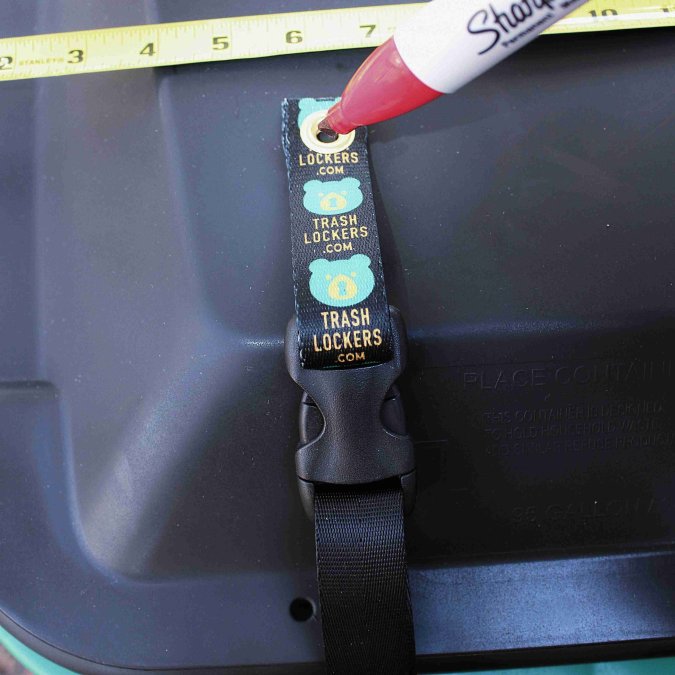
Step 2: Mark Drilling Locations Use the instructions to mark hole locations precisely with measuring tape and marker.
Step 3: Drill Mounting Holes Drill through marked locations with steady pressure. Wear safety glasses.
Step 4: Attach the Straps Slide bolts through washers, strap attachment points and drilled holes. Add thread nuts on the inside. Tighten firmly without over-torquing.
Step 5: Test the Locking Mechanism Engage the buckles and open/close several times to ensure smooth operation and catch any installation issues.
Step 6: Final Inspection Inspect all attachment points. Bolts should be tight, straps flat, and mechanism smooth. Tighten any loose bolts.
Certified Black Bear Resistant Trash Can Locks and Testing Standards
Certification matters. A product labeled as bear-resistant without third-party certification is essentially a marketing claim without verification.
Black bear-resistant testing certification verifies a product can withstand the unique, highly dexterous manipulation of black bears. Historically, wildlife agencies assumed that products capable of stopping a grizzly bear would automatically stop a black bear. However, because black bears utilize different foraging strategies—relying heavily on precise clawing, biting, and nimble problem-solving—organizations like the Wildlife Management Institute (WMI) created specialized testing frameworks tailored exclusively to regions populated solely by black bears.
The Live Black Bear Testing Protocol
To earn an official black bear-resistant designation, products undergo intense physical evaluation at approved facilities.
- The 60-Minute Contact Rule: Test bears must interact directly with the container for a total pool of 60 minutes of active contact time (rolling, pouncing, biting, and clawing).
- Olfactory Baiting: The trash cans or locks are packed with highly aromatic foods that bears crave—such as pies, mangoes, marshmallow cream, and chocolate syrup—often smeared directly onto the locking mechanism or straps to guarantee focused attention.
- The Failure Threshold: If a black bear manages to breach the lock and retrieve any food, or if the mechanism fails to function properly afterward, the product fails immediately. For soft-sided containers, any puncture hole exceeding 1/4 inch constitutes a total failure.
The Purpose Behind the Standards
Preventing black bear access to residential trash is critical for local ecosystems. When a black bear successfully raids an uncertified trash lock, it quickly becomes food-conditioned and habituated to human neighborhoods. This behavior strip-mines their natural foraging habits, escalates property damage, and frequently results in wildlife authorities having to euthanize the bear to protect public safety.
Ultimate Black Bear Trash Locks →

Raccoon Proof Garbage Can Locks and Multi-Animal Protection
While bears receive significant attention in wildlife management discussions, raccoons cause more frequent trash-related problems for most homeowners. Raccoons are smaller, more agile, and possess problem-solving intelligence that rivals many primates. A lock that stops bears will also stop raccoons, but the reverse isn't always true.
Raccoons exploit small gaps and use their dexterous front paws to manipulate objects. They test mechanisms methodically, remembering what works on subsequent visits. A system that provides multi-animal protection needs to address raccoon behavior specifically.
Bear resistant trash can locks that use multiple straps and enclosed buckle systems naturally provide raccoon protection. The straps eliminate gaps at the lid edge, and the buckle mechanism offers nothing for small paws to manipulate. Possums, skunks, and other nuisance wildlife are similarly deterred by systems designed for larger, stronger animals.
The key difference between single-animal and multi-animal protection is thoroughness. This is why comprehensive solutions like the TrashLockers Original and Ultimate locks protect against the full range of wildlife that raids trash cans.

Compatibility With Standard Bin Sizes and Materials
Garbage carts come in standard sizes: 32-gallon, 65-gallon, and 96-gallon capacities. Most residential carts fall into the 65 and 96-gallon range.
Retrofit design means the locks attach to your existing cart without replacing it. This is critical because new carts cost hundreds of dollars, while retrofit locks cost significantly less. A quality lock system works with carts manufactured by major producers like Toter, Rehrig Pacific, and others that supply municipal waste collection services.
Cart materials vary. Most residential carts are polyethylene plastic with metal reinforcement, while some premium models use heavier plastic or composite materials. The lock system must accommodate these variations without requiring custom drilling or modifications.
Stainless steel hardware ensures compatibility with different materials without corrosion. Plastic carts won't corrode the bolts, and the bolts won't damage the plastic through chemical reaction. This matters for longevity, a system with inferior hardware will fail prematurely as rust weakens the connection or corrosion damages the cart.
Cart Size |
Typical Household |
Lock Strap Count |
Installation Difficulty |
|---|---|---|---|
32-gallon |
Small families, apartments |
2 straps |
Easy |
65-gallon |
Standard household |
2-4 straps |
Easy |
96-gallon |
Large families, commercial |
4 straps |
Easy |
The TrashLockers Original locks use two straps and fit standard 35, 65, and 96-gallon carts. The Ultimate version adds two additional side straps for enhanced security on flexible lids. Both systems are designed as true retrofits, they work with what you have.
Durability, Maintenance, and Seasonal Care
A lock system's value depends on how long it lasts. Understanding the lifespan of each component helps you plan for replacement and avoid unexpected failures.
High-quality bear resistant trash can locks use UV-stabilized polyester that resists degradation from sunlight. The buckles are engineered to flex without breaking, and stainless steel hardware provides corrosion resistance. Even with these materials, the system will eventually wear.
Seasonal care varies by climate. In regions with heavy snow and ice, inspect bolts monthly during winter to ensure they remain tight. Snow load and freeze-thaw cycles can loosen fasteners.
Wind and weather can bend the cart or shift the attachment points, causing misalignment.
Odor Management and Attractant Reduction Strategies
Securing the trash is only half the battle. Wildlife is attracted by odor long before they attempt to open a cart. A locked cart that smells strongly of food will still draw bears and raccoons, they'll simply work harder to access it. Effective wildlife prevention combines physical security with odor management.
Frequently Asked Questions
Are bear resistant trash can locks actually certified, and what does that certification mean?
Yes, the best bear resistant trash can locks carry third-party certification from organizations like the Wildlife Management Institute (WMI). This certification means the lock has been tested against actual bear behavior and proven to withstand their strength and intelligence. For example, the Ultimate Black Bear Trash Locks are certified as Black Bear Resistant, meaning they've passed rigorous testing standards. When shopping, look for products with published certification numbers—this proves the lock has been independently verified, not just marketed as bear-proof.
How do raccoon proof garbage can locks differ from bear resistant locks?
Raccoon proof garbage can locks focus on preventing smaller animals from opening lids and prying into gaps, while bear resistant locks are engineered to withstand the force and persistence of much larger animals. Most quality bear resistant locks also protect against raccoons, possums, rats, and dogs because they secure the lid tightly and eliminate leverage points. However, a lock designed only for raccoons won't stop a bear. If you live in an area with both raccoons and bears, choose a bear resistant option—it handles both threats.
Will a bear resistant trash can lock fit my existing garbage bin, or do I need to buy a new cart?
Most bear resistant locks are retrofit designs, meaning they're built to fit standard garbage carts you already own. They work with common bin sizes from 32 to 96 gallons and attach using stainless steel bolts and nuts that permanently secure to your existing cart. Before ordering, confirm your bin's size and lid type (hinged or flexible). Retrofit locks eliminate the cost of replacing your entire bin while providing the same protection as a new container.
How hard is it to use a bear resistant trash can lock every day?
Quality bear resistant locks are designed for single-handed operation, meaning you can open and close them quickly without tools or two hands. Most use buckle-style fasteners with a break-force of around 300 pounds, making them secure yet easy to manipulate. Installation takes longer than daily use—once bolted to your cart, opening the lock becomes as simple as releasing a buckle and lifting the lid. This practical design is essential for homeowners who need to secure trash multiple times per week without frustration.
You Might Also Like


 USD
USD EUR
EUR
 CAD
CAD
 CHF
CHF
 JPY
JPY


